Delaware Financial Literacy Standards and Policy Ranking

The Delaware Financial Educators Council (DFEC) is the state advocacy chapter of the National Financial Educators Council (NFEC). Our role is to advance policy, standards alignment, and statewide action to ensure that Delaware students graduate prepared to manage real-world financial decisions.

The NFEC conducts national research and develops academic standards. DFEC translates that research into policy advocacy specific to Delaware. Our shared mission is to ensure that all learners graduate prepared to navigate real-world financial decisions by elevating financial education to the same level of quality, accountability, and instructional integrity as other required core academic subjects.
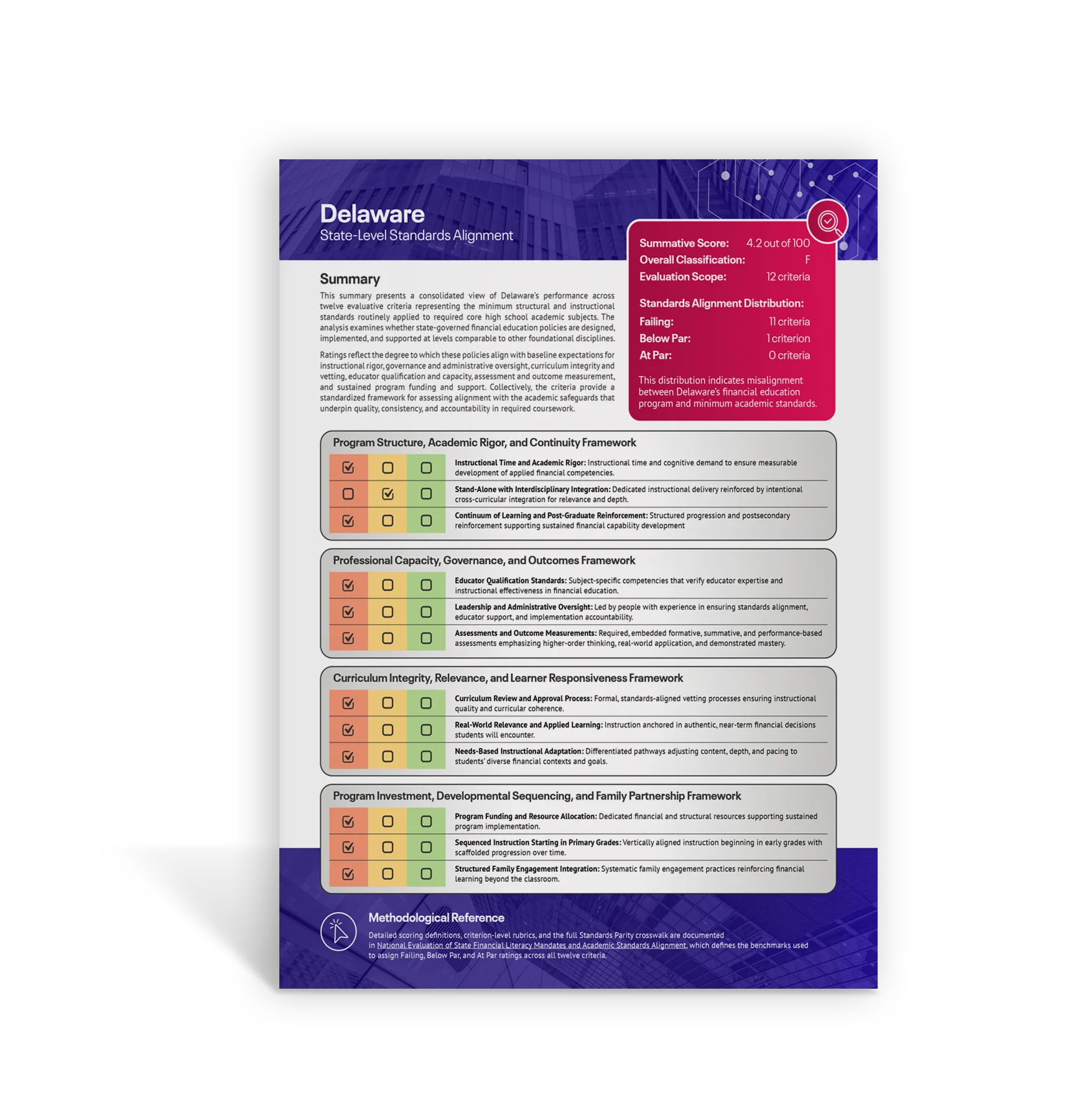
Delaware Financial Education Standards Alignment: A State-Level Policy Assessment

According to a review conducted by the National Financial Educators Council (NFEC), Delaware’s financial education standards do not align with the baseline academic expectations typically associated with core high school subjects such as mathematics, science, and English/language arts. Applying a standardized 12-criterion methodology across all 50 states, the NFEC assessed whether state-directed financial education policies satisfy essential requirements related to instructional rigor, governance structures, curriculum integrity, teacher preparedness, assessment systems, and ongoing program support.

The results of this analysis point to significant shortcomings in Delaware’s ability to meet established benchmarks for comprehensive financial literacy education. The state received an overall alignment score of 4.2 out of 100, resulting in a “Failing” classification and indicating widespread deficiencies across the framework. Among the 12 criteria evaluated, 11 were rated as Failing, one fell into the Below Par category, and none achieved an At Par designation. This pattern highlights a lack of sufficient rigor, consistency, and scope within current standards, limiting their effectiveness in delivering meaningful financial education outcomes for students statewide.

Delaware Financial Education Assessment

DFEC’s Advocacy Focus in DelawareDFEC’s Advocacy Focus in Delaware

DFEC works to ensure that financial education is treated as a core academic subject rather than optional enrichment. Our advocacy is organized to advance priorities that align Delaware’s policy environment with established academic expectations.

Research & Policy Guidance

DFEC promotes financial education policies aligned with core academic standards, emphasizing clear outcomes, educator preparedness, and accountability. Grounded in national research, DFEC works with educators, community leaders, and policymakers to identify gaps, evaluate legislation, and support scalable, standards-aligned implementation.

Standards for Financial Educators and Learners

DFEC supports the adoption of comprehensive learner outcome standards and educator competency frameworks to strengthen instructional quality statewide. By providing clear benchmarks for what students should know and be able to do – and what educators must demonstrate to teach effectively – DFEC helps establish consistent expectations that support long-term financial capability development.

Closing Statement

Delaware’s students deserve more than exposure to financial concepts; they deserve real preparation for the financial decisions that shape adulthood. These findings reveal a clear opportunity to strengthen financial education by aligning it with the rigor and accountability applied to other core subjects.

By advancing standards-based reform and investing in quality implementation, Delaware can ensure that every student graduates financially prepared for life beyond high school. Meaningful progress requires collective action from educators, families, policymakers, and community leaders – working together to make financial education a foundational part of a future-ready education system.

National Financial Educators Council

Official Bill Detail and Text (Delaware General Assembly)

Bill History and Status (LegiScan)

Delaware Department of Education Financial Literacy Resources (includes standards and implementation guidance)

State chapters: Mission and impact

National Evaluation of State Financial Literacy Mandates and Academic Standards Alignment

State-Mandated Financial Literacy Standards: A Comprehensive National Review

Personal finance standards

Financial literacy teacher certification

How to teach college students about money

Delaware’s Financial Literacy Standards

As of 2026, Delaware requires a half-credit personal finance course for high school graduation, enacted by House Bill 203 (2025) – “The Equity and Inclusion in Financial Literacy for All High School Students in Delaware Act” – effective for the 2026-27 9th-grade cohort. Previously, financial literacy was optional at the district level with no statewide mandate. Source.

Delaware has K-12 personal finance standards, but they lack enforcement through graduation ties, instructional time, educator qualifications, or accountability. Falling below core subject rigor, these standards offer vague guidance and unclear progressions, leading to inconsistent instruction and limited assurance of meaningful student financial capability.

As stated by the Champlain College Center for Financial Literacy, which issues a National Report Card every other year grading each U.S. state on its financial education standards, Delaware historically was lagging in this regard: in 2015 the First State received an “F” mark. No personal finance instruction was included in Delaware’s high school graduation requirements at that time. Although Delaware had personal finance education benchmarks in place for schools that choose to offer it, there was no mandate that schools offer or that students take such a course.

Champlain did award Delaware extra credit for passing a 2009 law creating the Financial Literacy Education Fund. This law requires businesses that make short-term consumer loans (aka payday loans) and car title loans to pay an annual high-cost loan license fee of $1,500 for each licensed office. These funds are earmarked as grants to schools or organizations to fund K-12 financial literacy programs.

As of 2015, the Economic Education Council reported that – although personal finance is included in K-12 standards – no such standards were required to be implemented by districts, and no high school course was required to be offered and/or taken in Delaware schools.